
Synovus
From a mill worker's wages in a Columbus safe to the machines that help move the world's money — the story behind a hometown bank.
The Marker
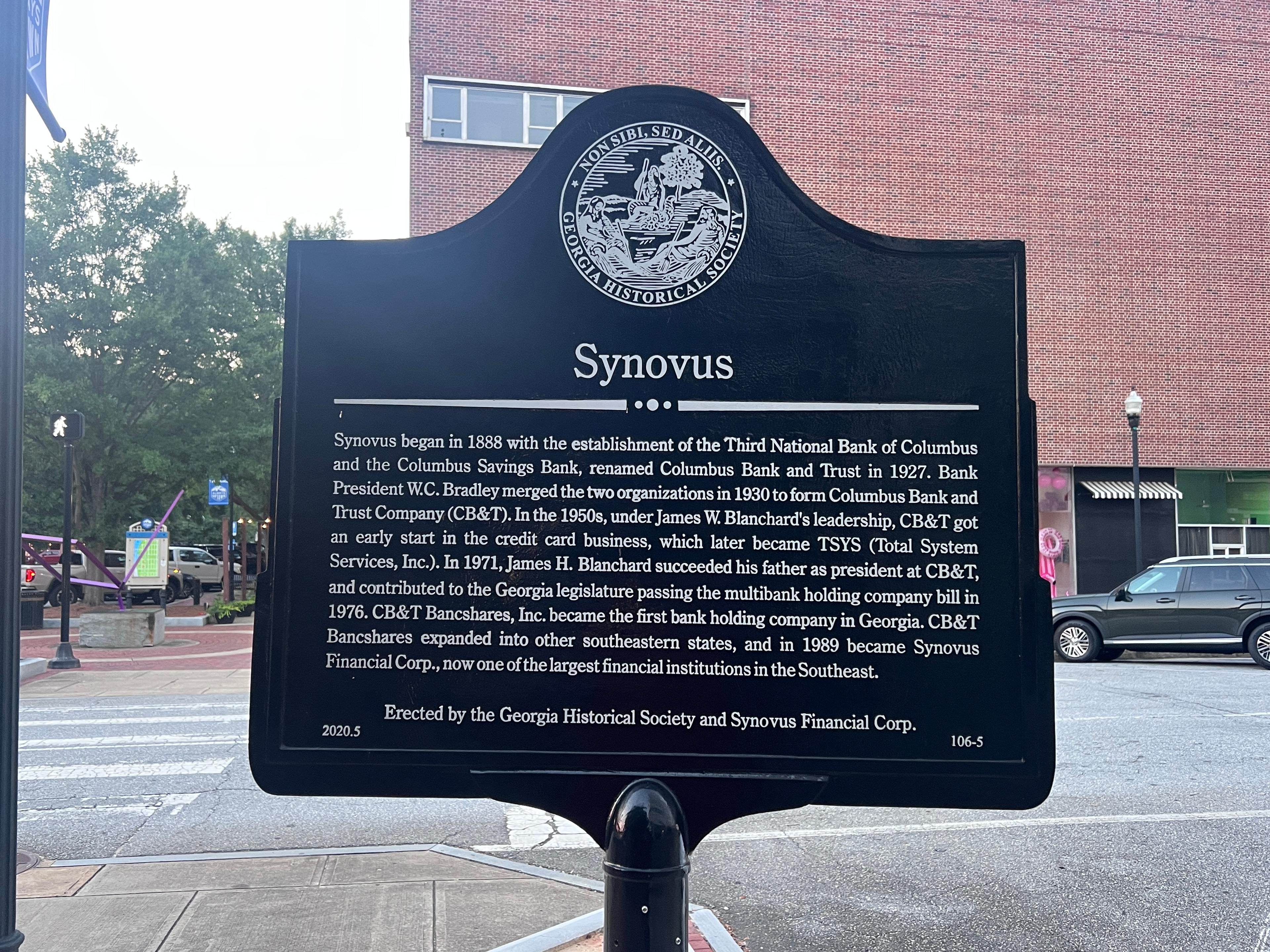
Synovus began in 1888 with the establishment of the Third National Bank of Columbus and the Columbus Savings Bank, renamed Columbus Bank and Trust in 1927. Bank President W.C. Bradley merged the two organizations in 1930 to form Columbus Bank and Trust Company (CB&T). In the 1950s, under James W. Blanchard's leadership, CB&T got an early start in the credit card business, which later became TSYS (Total System Services, Inc.). In 1971, James H. Blanchard succeeded his father as president at CB&T, and contributed to the Georgia legislature passing the multibank holding company bill in 1976. CB&T Bancshares, Inc. became the first bank holding company in Georgia. CB&T Bancshares expanded into other southeastern states, and in 1989 became Synovus Financial Corp., now one of the largest financial institutions in the Southeast.
Erected by Georgia Historical Society and Synovus Financial Corp., 2020.
Where it is
Street View, oriented toward the marker.
Sources
- Interior, City National Bank, Kearney, Nebraska — Solomon D. Butcher · Public domain (1910; author d. 1927).
- Eagle and Phenix Mills, Columbus, Georgia · Public domain.
- Synovus (Georgia Business History Initiative) — Georgia Historical Society
- Banks and Credit — Coronet Instructional Films · Public domain (CC Public Domain license).
- On Guard! The Story of SAGE — IBM Corporation, Military Products Division · Public domain (CC Public Domain mark; sponsored industrial film, copyright not renewed).
- Using the Bank — Encyclopaedia Britannica Films · Public domain (CC Public Domain license).
- Main street of Columbus, Georgia — Jack Delano · No known restrictions on publication (FSA/OWI black-and-white); public domain.
- Synovus · Marker text is public factual information; the photograph is © the project owner.
- Synovus Financial Corporation — New Georgia Encyclopedia
- Eagle & Phenix Mill and the Columbus RiverWalk, present day — Tony Latham (Living Markers) · © the project owner.
About this film
The narration is an AI-generated voice, not a human recording.
Archival imagery:
- Eagle & Phenix Mills, Columbus, Georgia — period postcard (public domain; via DPLA / Wikimedia Commons).
- A bank teller cage, ca. 1910 (public domain; period-representative, not the Columbus bank itself).
- Downtown Columbus, Georgia, 1941 — Jack Delano (Library of Congress, FSA/OWI; public domain).
- The Columbus RiverWalk on the Chattahoochee, present day (© the project owner).
- The Eagle & Phenix Mill today, on the Columbus RiverWalk (© the project owner).
- Bank vault and teller windows — "Using the Bank," Encyclopaedia Britannica Films, 1947 (public domain; Internet Archive / Prelinger).
- Bank check and ledgers — "Banks and Credit," Coronet Instructional Films, 1948 (public domain; Internet Archive / Prelinger).
- IBM mainframe interior — "On Guard! The Story of SAGE," IBM Corporation, ca. 1956 (public domain; Internet Archive / Prelinger).
More Markers
Nearby stories worth a look.

Mirabeau Buonaparte Lamar
Columbus, Georgia
He founded a Columbus newspaper, rode west into a revolution, and became the second president of the Republic of Texas.

First Black Public School
Columbus, Georgia
John Wilkes Booth once performed in the Columbus theater that, in 1872, became the city's first public school for Black children.

George Parker Swift I
Columbus, Georgia
A young man from Massachusetts, a cotton empire on the Chattahoochee, a city burned in the Civil War — and built again.