
Mirabeau Buonaparte Lamar
He founded a Columbus newspaper, rode west into a revolution, and became the second president of the Republic of Texas.
The Marker
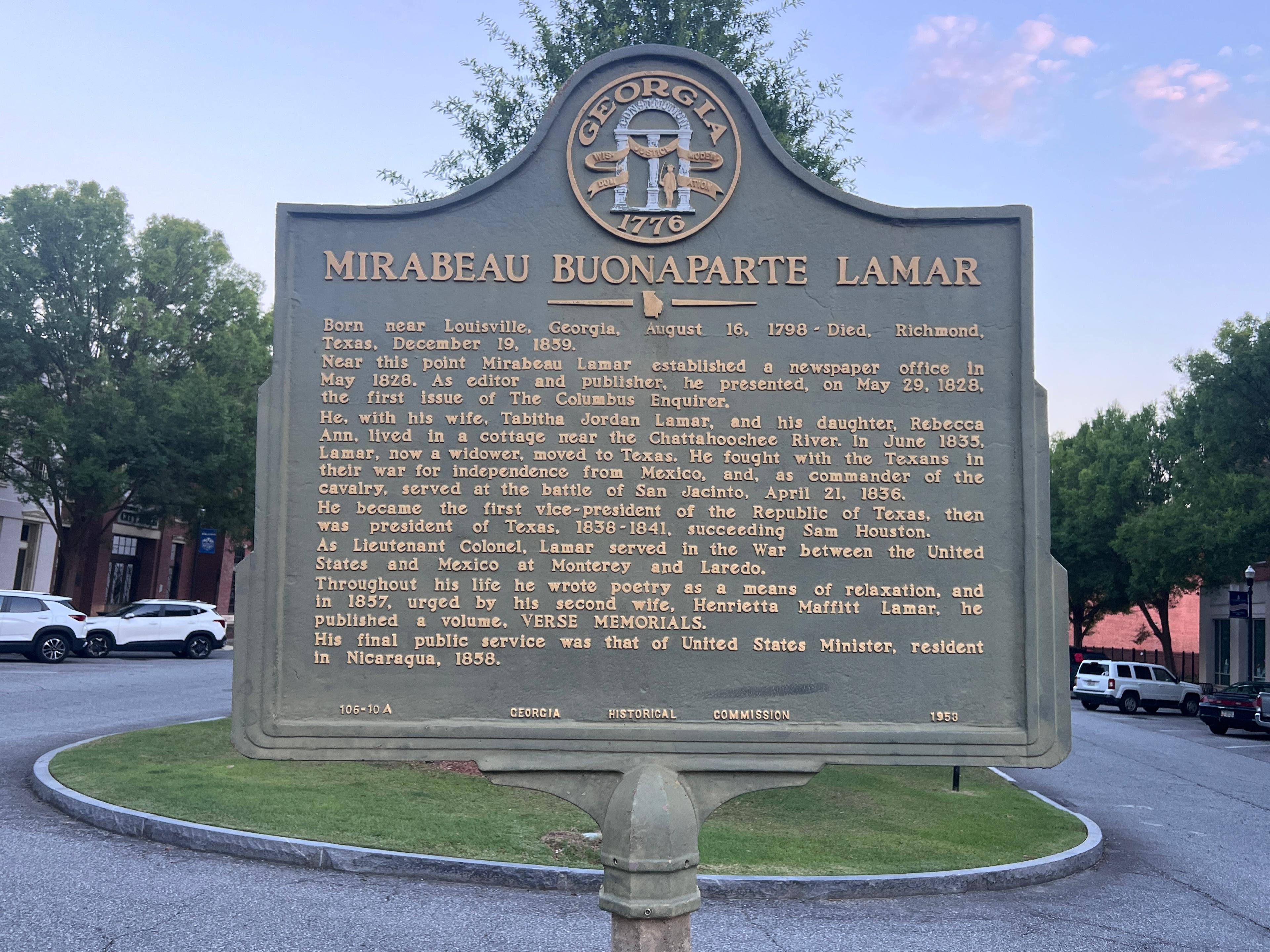
Born near Louisville, Georgia, August 16, 1798 — Died, Richmond, Texas, December 19, 1859. Near this point Mirabeau Lamar established a newspaper office in May 1828. As editor and publisher, he presented, on May 29, 1828, the first issue of The Columbus Enquirer.
He, with his wife, Tabitha Jordan Lamar, and his daughter, Rebecca Ann, lived in a cottage near the Chattahoochee River. In June 1835, Lamar, now a widower, moved to Texas. He fought with the Texans in their war for independence from Mexico, and, as commander of the cavalry, served at the battle of San Jacinto, April 21, 1836.
He became the first vice-president of the Republic of Texas, then was president of Texas, 1838-1841, succeeding Sam Houston.
As Lieutenant Colonel, Lamar served in the War between the United States and Mexico at Monterey and Laredo. Throughout his life he wrote poetry as a means of relaxation, and in 1857, urged by his second wife, Henrietta Maffitt Lamar, he published a volume, VERSE MEMORIALS. His final public service was that of United States Minister, resident in Nicaragua, 1858.
Erected by Georgia Historical Commission, 1956.
Where it is
Street View, oriented toward the marker.
Sources
- Mirabeau B. Lamar — Engraving from 'The Poets and Poetry of Texas' (1885) · Public domain (published 1885).
- Lamar, Mirabeau Buonaparte — Handbook of Texas / Texas State Historical Association; San Jacinto Museum veteran biography
- Mirabeau Buonaparte Lamar · Marker text is public factual information; the photograph is © the project owner.
- Mirabeau B. Lamar (1798-1859) — New Georgia Encyclopedia
About this film
The cinematic period scenes are AI-generated — a dramatized visualization, not real historical footage.
The narration is an AI-generated voice, not a human recording.
Archival imagery:
- Mirabeau B. Lamar — engraving from 'The Poets and Poetry of Texas,' 1885 (public domain; Wikimedia Commons).
More Markers
Nearby stories worth a look.
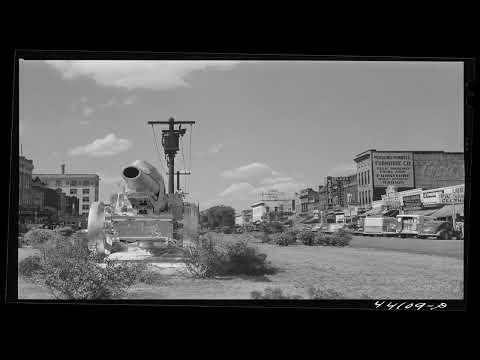
Synovus
Columbus, Georgia
From a mill worker's wages in a Columbus safe to the machines that help move the world's money — the story behind a hometown bank.
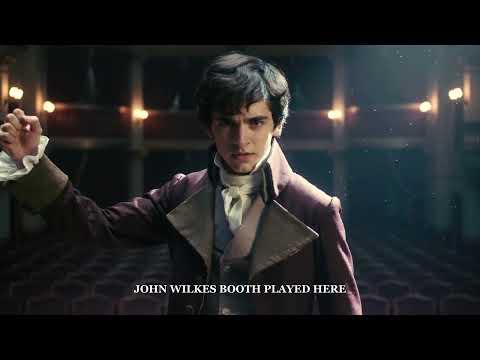
First Black Public School
Columbus, Georgia
John Wilkes Booth once performed in the Columbus theater that, in 1872, became the city's first public school for Black children.
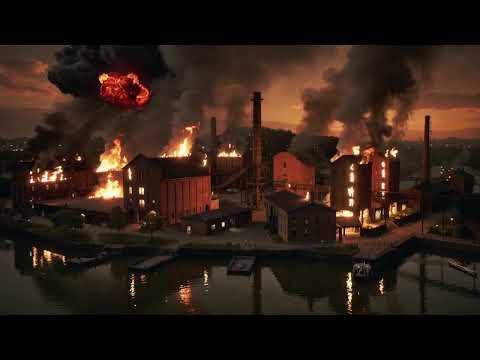
George Parker Swift I
Columbus, Georgia
A young man from Massachusetts, a cotton empire on the Chattahoochee, a city burned in the Civil War — and built again.